On a Singapore site, every square metre handed over to drainage is a square metre you have paid for and can no longer let, fit out or use. Capcon Engineering takes siphonic roof drainage on new builds and refurbishments across Singapore and the wider APAC region from design to maintenance, drawing on over 15 years in rainwater engineering, and we sit alongside design teams, contractors and M&E engineers from the first concept sketch through to handover, draining the roof fully while giving back as much plant room, ceiling void and ground as the building allows.
Working on a live project? Send us your tender drawings or outline brief via our contact page, and our siphonic drainage experts will review the options with you.
What is Siphonic Drainage?
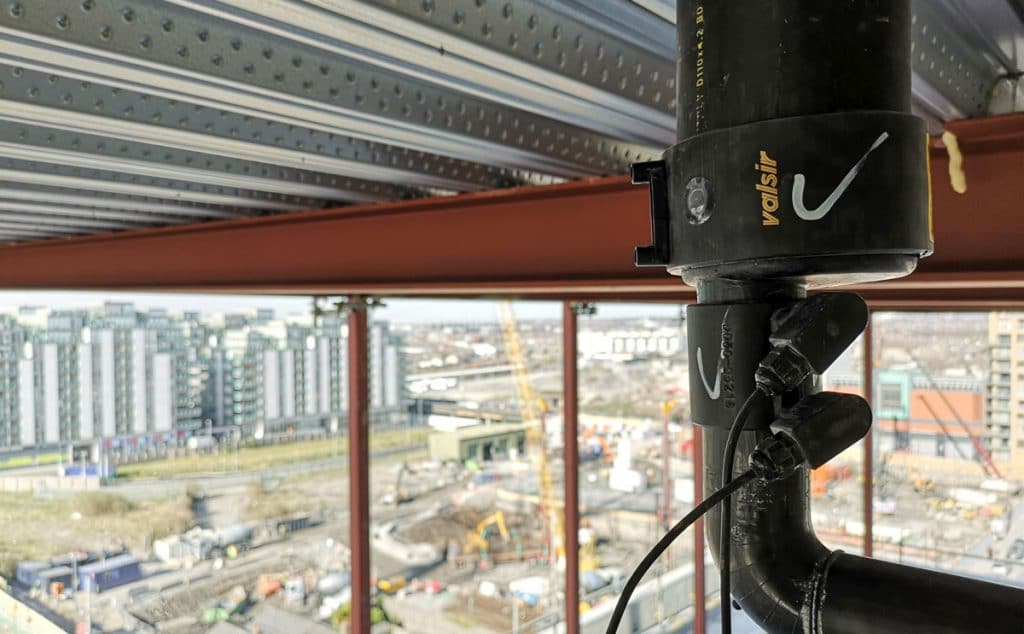
In a siphonic roof system, purpose-built outlets keep air out, so the pipes run completely full and the falling column of water pulls rain off the roof under negative pressure. Because suction does the work instead of gradient, collector pipes can run level at high level and feed just a handful of downpipes (our main page explains how siphonic drainage works step by step).
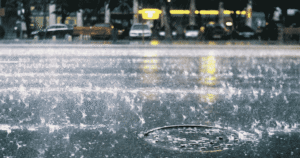
Singapore’s tropical climate delivers some of the most intense short-duration rainfall anywhere in the world, with annual totals regularly exceeding 2,500 mm and convective thunderstorms capable of dumping extraordinary volumes in a matter of minutes. A siphonic rainwater system handles these large volumes efficiently on flat, low-gradient roofs while requiring less pipework than a traditional gravity system. And it provides far greater protection against the kind of extreme weather events that are becoming more frequent across Southeast Asia.
Why Choose Siphonic Instead of Gravity in Singapore?
On tight urban plots, where land and floor area carry some of the highest values in the region, three advantages usually settle the question:
Level pipes in crowded ceiling voids, because zero-fall collectors do not eat into the depth already fought over by chilled water mains, ventilation ducts and cable trays, which helps keep floor-to-floor heights lean.
Fewer downpipes and less digging, which matters on reclaimed land with a high water table, where every metre of below-ground drainage is slow and costly to build and every downpipe removed frees floor space at ground level.
Typical cost savings of 20 to 45% compared with conventional gravity-based systems.
If you want to know how much ceiling depth and ground a siphonic layout could give back on your building, send us the drawings and design criteria and we will prepare a siphonic versus gravity comparison.
Additional Protection Against Extreme Weather Events in Singapore
Singapore sits just north of the equator in one of the most rainfall-intensive regions on the planet. Convective thunderstorms dominate, and short-duration precipitation events can be ferocious. Historical data from the Meteorological Service Singapore shows a trend towards higher hourly rainfall intensities, and the country’s total rainfall in 2024 reached approximately 2,740 mm, well above the long-term average of around 2,534 mm. Flash flooding events in areas like Yishun and Potong Pasir during November 2024’s record-breaking rainfall were a stark reminder that drainage capacity is not something you can afford to get wrong.
Siphonic drainage systems are increasingly important in Singapore because they:
- Remove large volumes of stormwater during high-intensity rainfall events, the kind of tropical downpours that overwhelm conventional gravity systems.
- Reduce the risk of roof ponding, structural overload and internal water ingress, protecting the high-value assets housed within data centres, pharmaceutical facilities and advanced manufacturing plants.
- Support compliance with evolving design storm criteria, including requirements set out in PUB’s Code of Practice on Surface Water Drainage and SS 525:2024, Singapore’s updated standard for roof drainage that now includes specific performance requirements for siphonic systems.
- Provide long-term protection for assets in a climate where rainfall intensity is projected to increase further under climate change scenarios.
- Decrease reliance on secondary overflow systems during extreme weather events.
Capcon Are the Siphonic Specialists
Rainwater drainage is all we have done for more than 15 years, on data centres, pharmaceutical plants, airports and factories from Ireland and the UK through the Middle East to Asia-Pacific.
We have a physical presence in Singapore, with our APAC office at 141 Cecil Street, Tung Ann Building. We are not a distant consultancy offering remote advice. We are here, on the ground, working with local teams and understanding the specific challenges of building in this market.
Expertise and Track Record in Singapore and APAC
Our team has designed and delivered siphonic drainage solutions on complex, high-profile projects, including:
- Changi Airport Terminal 5, Singapore: Construction began in May 2025 on this mega terminal that will handle approximately 50 million passengers annually in its first phase by the mid-2030s, with substructure and airside contracts valued at approximately S\$4.75 billion already awarded. Vast roof areas and complex architectural designs make siphonic drainage the natural choice for a project of this scale.
- Pharmaceutical facilities in Singapore and across APAC, including projects for major global pharmaceutical manufacturers who demand the highest levels of engineering rigour and coordination in densely serviced environments.
- Multiple data centres across Asia, designed to meet the stringent uptime, sustainability, and water-efficiency requirements of this rapidly growing sector.
- Advanced manufacturing facilities across the region, where siphonic systems deliver the combination of performance, space efficiency and cost savings that complex industrial buildings demand.
On each project, we work closely with architects, engineers and contractors to ensure the siphonic system integrates seamlessly with the roof build-up, structural framing and internal services, while meeting design storm criteria and client performance requirements.
Excellence in Design and Production
All siphonic systems are designed by our in-house engineering team in line with all relevant local codes and standards. For Singapore projects, this includes SS 525:2024 (Code of Practice for Drainage of Roofs, updated in 2024 to include enhanced performance requirements for siphonic roof drainage systems), PUB’s Code of Practice on Surface Water Drainage, and the Sewerage and Drainage Act, as amended in 2024. We also design to BS EN 12056-3, BS 8490, ASPE/ANSI 45 and other international standards when project specifications require it.
In buildings where every millimetre of void is contested, our designers model outlets, collectors and downpipes in BIM before anything is ordered and, if the programme allows, prefabricate pipework off-site so a tight urban site needs less laydown space and fewer hours of on-site fabrication.
Being certified to design and fit Valsir Rainplus, Hydromax and Blucher stainless-steel systems, among other brands, means we pick the system that fits the building and Singapore’s tropical conditions rather than working from a single catalogue.
Installation, Maintenance and Upgrades
The teams who fit our systems in Singapore are Capcon’s, sequencing their work around roofers, steel erectors and services installers, and we keep maintaining and upgrading systems after handover, including older installations that predate SS 525:2024. High humidity, heavy loads of organic debris from surrounding vegetation, and the sheer frequency of intense rainfall events all mean that regular inspection and maintenance are not just good practice but essential. For planned programmes, surveys, debris clearance and emergency call-outs, see what our siphonic drainage service covers.
Where Siphonic Roof Drainage Works Best in Singapore
Siphonic roof drainage systems are particularly well-suited to the types of large-footprint buildings that dominate Singapore’s commercial and industrial landscape:
- Data centres and technology facilities: Singapore’s data centre construction market is projected to reach approximately USD 6 billion by 2031, with the government allocating up to 300 MW of new capacity under its Green Data Centre Roadmap. These facilities demand absolute reliability in rainwater management. Any water ingress can be catastrophic for operations.
- Pharmaceutical and biomedical manufacturing: Singapore hosts regional headquarters for eight of the top ten global pharmaceutical companies, and major investments like AstraZeneca’s USD 1.5 billion antibody-drug conjugate facility are expanding the country’s manufacturing footprint. These are precisely the kinds of congested, high-value buildings where siphonic drainage excels.
- Airport terminals and aviation infrastructure: Changi Airport’s Terminal 5, now under construction, is one of the largest infrastructure projects in Southeast Asia. Siphonic systems are often the only viable solution for managing roof drainage across such vast, architecturally complex structures.
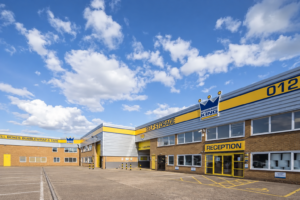
- Industrial, logistics and storage buildings: Singapore’s Jurong Industrial Estate, Tuas and other industrial zones house large-footprint facilities where reducing the number of downpipes and underground drainage runs delivers real cost savings.
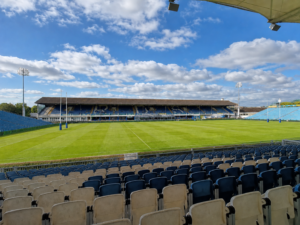
- Stadia, arenas and large commercial developments: Where architectural ambition meets large roof areas, siphonic drainage provides the flexibility that designers need.
Each siphonic rainwater system is custom-designed around the building’s use, location, roof geometry and discharge requirements, ensuring that roof drainage performance aligns with Singapore’s meteorological data and the building’s design life.
Supporting Singapore's Sustainability Goals
Singapore takes water seriously. Two-thirds of the country’s land area serves as water catchment, and PUB requires all new developments and re-developments of 0.2 hectares or more to implement on-site detention measures to slow down surface runoff and reduce peak flow into the public drainage system. The ABC Waters Programme promotes sustainable stormwater management through design features like bioretention basins, rain gardens and constructed wetlands.
Siphonic drainage fits naturally into this framework. By efficiently channelling roof runoff into attenuation tanks or rainwater harvesting systems, siphonic designs support compliance with PUB’s stormwater management requirements while contributing to BCA Green Mark certification. The Green Mark 2021 framework, which is tailored specifically for tropical climates, awards credits for water efficiency measures, including rainwater harvesting and reduced mains water consumption. Siphonic systems make this integration straightforward.
For data centres in particular, where water is a critical operational resource for cooling, pairing siphonic drainage with rainwater harvesting can directly improve Water Usage Effectiveness (WUE) and support the sustainability targets that Singapore’s Green Data Centre Roadmap now demands.
How We Support Different Project Stakeholders in Singapore
Architects can bring us in at concept stage to test whether siphonic suits the roof, set outlets around the structural grid and strip out visible downpipes, freeing facade and floor area that would otherwise be lost to rainwater pipes. For main and M&E contractors, we supply buildable layouts already checked for clashes, plus factory-made pipe assemblies that reduce site labour and the laydown space a congested Singapore site rarely has to spare, with our support running through testing and commissioning. Consulting engineers and specifiers can rely on us for hydraulic calculation packs to SS 525:2024, verification of schemes drawn up by others and guidance on pairing siphonic with gravity or rainwater harvesting, all aimed at meeting PUB and BCA requirements within the smallest practical service zone.
Our CPD “An Introduction to Siphonic Drainage” is approved by Engineers Ireland and certified by CPD UK, and can be delivered virtually or in person to project teams and design practices in Singapore.
Contact Our Singapore Office
Capcon Engineering has a dedicated APAC office to serve projects across Singapore and the wider region:
Capcon Engineering, Singapore
141 Cecil Street, 04-05 Tung Ann Building, Singapore 069541
Phone: +6012 385 1975
Email: info@capconeng.com
Whether you are at the tender stage, early design or looking to upgrade an existing system, get in touch with your drawings and design criteria. Our siphonic drainage specialists will review the options and advise on the best approach for your project.
Siphonic Roof Drainage Experts
Meet Donnacha Tobin
Find out how we can design and supply a bespoke siphonic drainage solution for your next project by speaking directly with our Divisional Director.