If you’re researching roof drainage options for a commercial building project, you’ve likely come across siphonic systems. They promise smaller pipes, fewer downpipes, and significant cost savings. But how do they actually work? Are they right for your project? And what about maintenance?
This guide answers the most common questions we hear from architects, engineers, and building owners about siphonic roof drainage. Whether you’re designing a new warehouse in Birmingham or retrofitting an ageing distribution centre in Leeds, this should give you the clarity you need.
What Is a Siphonic Roof Drainage System?
A siphonic roof drainage system removes rainwater from flat or low-gradient roofs using negative pressure rather than gravity alone. Think of it as the difference between pouring water down a drainpipe versus actively sucking it through one.
Traditional drainage relies on water flowing downhill through partially filled pipes. Siphonic systems, by contrast, fill their pipes completely during operation, creating a vacuum effect that pulls water off the roof at much higher velocities.
The result? You can drain the same amount of water through significantly smaller pipes, run those pipes horizontally without any gradient, and use far fewer downpipes overall. A warehouse roof that might need 20 conventional downpipes could potentially be served by just a handful of siphonic outlets.
How Do Siphonic Roof Drains Work?
The magic happens through a combination of clever engineering and basic physics. Here’s the process:
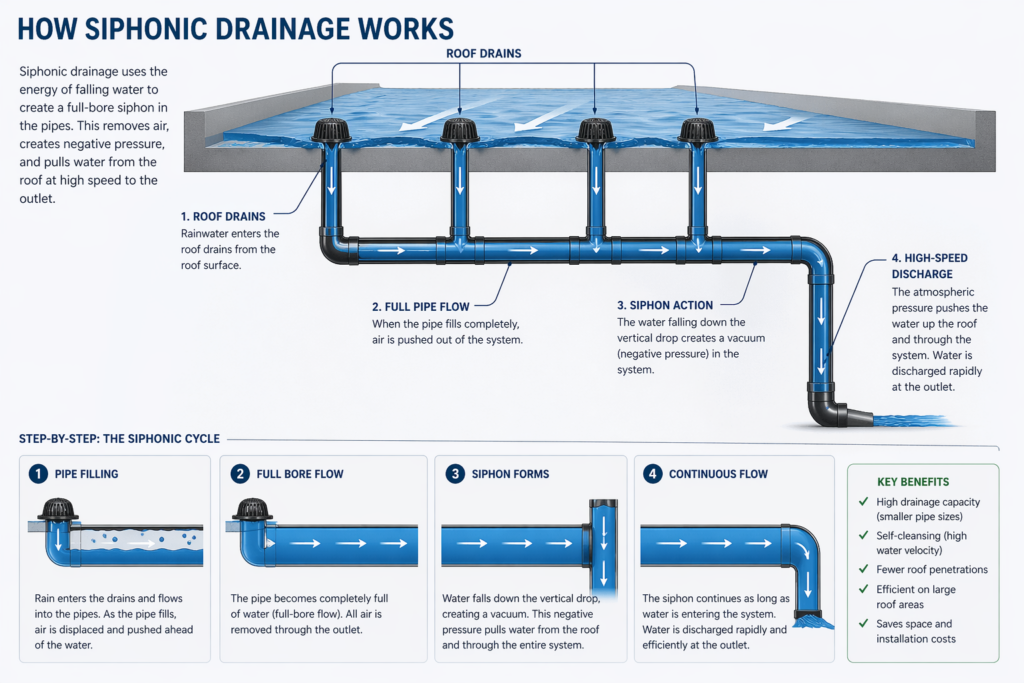
The components: Each system uses specially designed roof outlets fitted with anti-vortex baffle plates. These baffles prevent air from entering the pipework, which is absolutely critical. The outlets connect to horizontal collector pipes, which then feed into vertical downpipes that discharge at ground level.
The priming process: When rainfall begins, water collects at the roof outlets. Initially, the system behaves like conventional drainage. But as rainfall intensity increases and water depth builds, the outlets become submerged. The baffle plates prevent air from being drawn in, and the pipes begin filling completely with water.
Full-bore flow: Once the pipes are running full, the siphonic action kicks in. The weight of water in the vertical downpipe creates negative pressure that actively draws water through the horizontal runs. Flow velocities can exceed 3 metres per second, compared to perhaps 1 metre per second in gravity systems.
Self-cleaning: These high velocities are actually beneficial. Any sediment or debris gets flushed through rather than settling in the pipes. Industry guidance suggests minimum velocities of 1.0 m/s to maintain this self-cleansing effect.
One important clarification: despite the name, siphonic drainage doesn’t work exactly like a drinking straw siphon. The principle is similar, but the hydraulics are more complex. Specialist design software is essential for sizing these systems correctly.
What’s the Difference Between Siphonic and Traditional Gravity Drainage?
The fundamental difference lies in how water moves through the pipes.
Gravity systems operate with pipes running roughly 50% water and 50% air. They need continuous fall (gradient) to keep water moving. The pipes are typically larger, and you need more of them to handle the same flow rate.
Siphonic systems run 100% full when operating at design capacity. No gradient required for horizontal runs. Smaller pipes. Fewer outlets.
Here’s a practical comparison:
| Factor | Gravity Drainage | Siphonic Drainage |
| Pipe capacity | ~33-50% water | 100% water |
| Horizontal gradient | Required (typically 1:80 minimum) | None required |
| Typical pipe diameter | Larger | 40-50% smaller |
| Number of downpipes | More | Fewer |
| Underground drainage | Extensive networks | Dramatically reduced |
| Design complexity | Straightforward | Requires specialist software |
Neither system is universally better. Gravity drainage remains perfectly adequate for smaller buildings or simple roof layouts. Siphonic systems shine on large, complex projects where the benefits compound.
What Are the Key Benefits of Siphonic Roof Drainage?
Faster water removal. A single DN75 siphonic outlet can handle flow rates exceeding 20 litres per second, more than double a conventional outlet of similar size.
Space savings. No gradient means horizontal pipes can run level above suspended ceilings or through congested service zones. Invaluable in data centres and pharmaceutical facilities where every centimetre matters.
Reduced infrastructure. Fewer downpipes means less building envelope penetration. Less underground drainage means reduced excavation and simpler coordination with foundations.
Cost savings. Industry sources report savings of 25 to 45 percent compared to gravity solutions, from reduced materials, less excavation, and shorter programme times.
Rainwater harvesting compatibility. Siphonic systems efficiently channel roof runoff into attenuation or harvesting systems. Concentrated flow simplifies collection infrastructure.
Reduced flood risk. High flow capacity provides genuine protection against increasingly intense UK rainfall events.
What Types of Buildings Are Siphonic Systems Suitable For?
Siphonic drainage really comes into its own on:
- Large industrial buildings such as warehouses, distribution centres, and manufacturing facilities with extensive flat roofs
- Commercial developments including shopping centres, office complexes, and multi-storey car parks
- Transport infrastructure such as airport terminals, railway stations, and bus depots
- Healthcare facilities where space above ceilings is at a premium
- Data centres where reliability and space efficiency are paramount
The technology suits buildings with roof areas collecting roughly 80 litres per second or more at design rainfall intensity. For smaller buildings, the technical benefits may not justify the specialist design input required.
Where siphonic might not be ideal: Very small roofs (under 500 square metres, roughly speaking) won’t generate sufficient flow to prime the system reliably. Complex roof geometries with multiple small catchment areas can also prove problematic. In these situations, conventional drainage often makes more sense.
What Are the Costs? Are They Cheaper Than Traditional Drainage?
On balance, yes. But the picture is nuanced.
Upfront component costs for siphonic outlets and specialist fittings are typically higher than standard rainwater goods. The system also requires specialist hydraulic design, which adds professional fees.
However, total installed costs are usually lower because:
- Pipe diameters are smaller, reducing material costs
- Fewer downpipes means less installation labour
- Horizontal runs need no gradient, simplifying fixing and routing
- Underground drainage is dramatically reduced, cutting excavation and civil works
- Programme time is often shorter
Real-world projects commonly achieve savings of 25-45% against equivalent gravity solutions. Some projects report even greater savings depending on site conditions.
The key is engaging a specialist designer early. Trying to shoehorn siphonic drainage into a project after the structure is designed rarely works well.
What UK Standards and Regulations Apply?
Two British Standards govern siphonic roof drainage in the UK:
BS EN 12056-3:2000 covers the general layout and calculation of roof drainage systems, including performance criteria for siphonic systems. It superseded the earlier BS 6367:1983.
BS 8490 provides specific guidance on siphonic roof drainage design, installation, verification, and maintenance. The current edition (BS 8490:2025, published February 2025) supersedes the 2007 version and introduces important changes, including requirements for both primary and secondary drainage systems on internal gutters.
Building Regulations Approved Document H (Section H3) addresses rainwater drainage requirements. Complex systems in larger buildings must conform to BS EN 12056. Siphonic systems designed to these standards satisfy regulatory requirements.
A note on older installations: Systems designed before 2000 under BS 6367:1983 may be undersized by modern standards. The 2007 revision of BS 8490 added 10% to required capacity to reflect increasing rainfall intensities. If you’re responsible for a building with an older system, it’s worth having it assessed.
Do Siphonic Roof Drains Require Special Maintenance?
All roof drainage needs maintenance. Siphonic systems are no exception, though not necessarily more demanding than conventional alternatives.
Routine requirements: Gutters and outlet baffles should be inspected and cleaned 3-4 times annually, depending on local conditions. Buildings surrounded by trees or in industrial areas may need more frequent attention. BS 8490:2025 recommends minimum four inspections per year.
What you’re checking for: Keep the anti-vortex baffle plates clear. Debris blocking the baffles prevents proper system priming. Leaves, moss, and bird detritus are the usual culprits.
The self-cleaning advantage: High flow velocities mean sediment and smaller debris flush through rather than accumulating in pipes. You don’t typically need internal pipe cleaning or access points for rodding.
Maintenance records: Document your inspections. This protects warranties and demonstrates due diligence.
Can Siphonic Systems Handle Extreme UK Weather?
This is precisely what they’re designed for.
Siphonic systems are sized for specific design storms, typically a 1-in-100-year return period for commercial buildings. During exceptional storms, properly designed systems prime quickly, remove water at rates far exceeding gravity alternatives, and maintain performance during extended heavy rainfall.
The concentrated nature of siphonic outlets (fewer locations, higher individual capacity) can be advantageous during flash storms compared to multiple smaller conventional outlets that may become overwhelmed individually.
No drainage system handles infinitely extreme rainfall. Secondary overflow provisions remain important, and BS 8490:2025 now mandates secondary systems for internal gutters.
FAQs
What is siphonic roof drainage used for?
Draining rainwater from large flat or low-gradient roofs on commercial and industrial buildings where efficiency, space savings, and cost reduction matter.
How much slope is needed for siphonic roof drainage?
None for the horizontal pipework. That’s one of the key advantages. Vertical drops are still needed, but horizontal collector pipes can run completely level.
Are siphonic roof drains acceptable under UK building regulations?
Yes. Systems designed to BS EN 12056-3 and BS 8490 satisfy Approved Document H requirements for rainwater drainage.
Can siphonic drainage be retrofitted to an existing roof?
Often, yes. You’ll need adequate space in the roof void for horizontal pipework, and the existing structure must support the outlet positions. A specialist survey is essential to assess feasibility.
How many roof outlets do I need?
It depends entirely on roof area, shape, and local rainfall intensity. Siphonic systems typically use far fewer outlets than gravity alternatives, but precise numbers require hydraulic calculations by a qualified designer.
Can siphonic drains be connected to traditional drainage?
Yes, at the discharge point. The siphonic system handles roof drainage down to ground level, where it typically connects into conventional below-ground drainage.
Expert Tips for UK Projects
Engage early. Bring a siphonic drainage specialist into the design team at RIBA Stage 2 or 3. Retrofitting the technology into a developed design is difficult and expensive.
Coordinate with structure. Outlet positions affect steelwork and roof falls. Early coordination prevents costly late changes.
Consider rainwater harvesting. If your client has sustainability targets or water-intensive operations, siphonic systems integrate well with attenuation and harvesting infrastructure.
Check the existing condition. For refurbishment projects, survey the current system thoroughly. Older installations may be undersized for modern rainfall expectations.
Demand proper design documentation. Hydraulic calculations, system drawings, maintenance schedules, and operating manuals should all be provided.
Conclusion
Siphonic roof drainage offers genuine advantages for large UK commercial and industrial projects: faster water removal, smaller pipes, fewer penetrations, reduced underground drainage, and meaningful cost savings. The technology is well-established, covered by British Standards, and accepted under Building Regulations.
Before specifying a siphonic system, confirm that:
- The roof area is large enough to benefit (typically 500+ square metres)
- Early design engagement is possible
- Budget includes specialist design input
- Maintenance arrangements are understood
Proper design is everything with siphonic systems.