Designing for Rainfall Extremes, Not Averages.
British weather has always been unpredictable. But being unpredictable is one thing. What we’re seeing now is something else entirely.
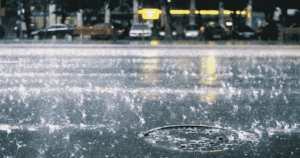
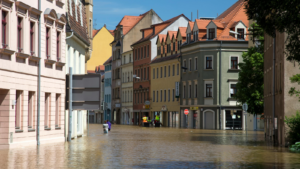
The winter of 2023-24 was the third wettest on record, with seventeen named storms battering the UK between October and March. Storm Babet alone caused four fatalities and flooded over 2,200 homes. In September 2023, Exeter Airport’s terminal flooded and temporarily closed after thunderstorms dumped intense rainfall across Devon. These aren’t anomalies anymore. They’re the new normal.
For critical infrastructure, airports, stadiums, and data centres, this shift demands a fundamental rethink. All three share an uncomfortable reality: massive roof catchments, zero tolerance for operational failure, and consequences that spiral far beyond a bit of damp carpet.
The old approach of simply draining the roof and hoping the sewers cope is no longer fit for purpose. What’s needed is system-wide water resilience, where capture, conveyance, storage, and controlled discharge work together as an integrated whole.
Why Large Infrastructure Fails During Heavy Rain
When drainage systems fail on critical buildings, it’s rarely one catastrophic problem. More often, it’s a cascade of smaller issues that combine during exactly the wrong moment.
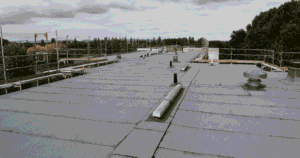
Roof ponding is the classic culprit. Large, flat roofs can accumulate thousands of litres within minutes during intense rainfall. If outlets can’t keep pace, or worse, if debris partially blocks them, water depth builds. Structural engineers design for specific load limits. Exceed them, and you’re looking at potential roof collapse, not just leaks.
Then there’s the bottleneck problem. Water might leave the roof efficiently enough, but where does it go? Undersized downpipes, inadequate below-ground connections, or surcharging public sewers can create backups that flood the very spaces you’re trying to protect.
Perhaps the most overlooked failure? The absence of defined exceedance routes. Every drainage system has a design limit. What happens when rainfall exceeds it? Without planned overflow paths, water finds its own route, typically through doors, into plant rooms, or pooling in car parks where people and vehicles are moving.
Meeting minimum code requirements isn’t the same as achieving genuine resilience. For airports where operational disruption costs millions, stadiums where crowd safety is paramount, or data centres where water and electricity absolutely must not meet, compliance is just the starting point.
A Resilience-First Stormwater Design Framework
Effective stormwater management for critical infrastructure follows three interconnected stages: capture, conveyance, and control. Get any one wrong, and the whole system underperforms.
Capture: Managing Rainfall at Roof Level
Large-span roofs demand drainage systems capable of moving extraordinary volumes quickly. A 10,000m² roof during a 75mm/hour storm event generates over 200 litres per second of runoff. That’s roughly filling a bathtub every two seconds.
Modern high-capacity roof drainage, including siphonic systems where appropriate, can handle flow rates far exceeding traditional gravity-fed approaches. The key design priorities aren’t about choosing one technology over another. They’re about redundancy (multiple outlets so blockage of one doesn’t cause failure), clear flow paths (no tortuous routes that slow water down), and emergency overflow that directs excess water to safe locations rather than letting it find its own way.
Conveyance: Moving Water Safely Through the Building
Getting water off the roof is only half the battle. Where pipework routes through the building matters enormously.
In an airport terminal, you don’t want drainage running directly above check-in desks or security equipment. In a data centre, keeping pipework away from server halls, electrical switchgear, and UPS rooms isn’t optional. Even stadiums need careful routing to avoid plant areas and circulation spaces where crowds move.
The advantage of engineered drainage systems, particularly siphonic approaches, is the flexibility they offer. Horizontal pipe runs can travel significant distances without the continuous fall that gravity systems require. This opens up routing options that traditional drainage simply cannot match in buildings with complex layouts and congested service zones.
Control: Attenuation, Storage, and Discharge
Raw drainage speed isn’t always desirable. Public sewers and watercourses have capacity limits. Overwhelming them during peak rainfall shifts the flooding problem from your site to someone else’s, and potentially back again when backups occur.
Attenuation, holding water on site and releasing it slowly, is now expected on most major developments. This might involve below-ground tanks, blue roofs that temporarily store water on the roof surface, or integration with green infrastructure like swales and rain gardens. The National Planning Policy Framework now requires major commercial developments to implement Sustainable Drainage Systems (SuDS) unless demonstrated inappropriate, with climate change allowances of up to 40% added to design rainfall calculations.
Airports: Uniquely Exposed to Heavy Rain
Aviation operates on tight margins. A flooded terminal doesn’t just inconvenience passengers. It cascades through departure schedules, connecting flights, and crew rosters for hours or days afterwards. Storm Henk in January 2024 brought winds of 111 km/h to Heathrow alongside over 250 flood warnings nationally, causing widespread travel disruption.
Airport terminals present drainage designers with enormous roof catchments, often measured in hectares rather than square metres. Add to this the constraint that visible pipework disrupts architectural aesthetics, and drainage must thread through buildings where maintenance access is restricted during operational hours.
High-capacity roof drainage systems designed for intense rainfall events are standard for modern terminals. But equally important are engineered overflow routes that don’t discharge onto passenger walkways or critical airside infrastructure. The Gatwick floods of 2013-14 demonstrated what happens when drainage is overwhelmed: 145 cancelled flights and an estimated £3.2 million economic impact.
Landside drainage matters too. Attenuation and flow control prevent surcharging of airport drainage into public systems, while water quality treatment addresses contamination from de-icing fluids and fuel residues in operational areas.
Stadiums and Arenas: When the Roof is the Show
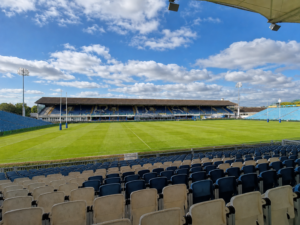
Stadium architecture has evolved dramatically. Where once roofs simply covered spectators, today’s designs feature sweeping cantilevers, retractable sections, and complex geometries that define the venue’s identity. These architectural statements create drainage challenges that conventional approaches struggle to address.
Consider a typical bowl roof draining towards the pitch. During heavy rain, water accelerates down the slope, concentrating at the lowest points with increasing velocity. Traditional gravity systems would require numerous downpipes around the perimeter, each needing large-diameter runs through the structure, exactly where premium seating and hospitality areas generate revenue.
Siphonic drainage has become common in major stadiums precisely because it offers an alternative. The Allianz Arena in Munich, Warsaw’s National Stadium, and numerous Premier League grounds use siphonic systems to manage roof drainage with fewer, strategically positioned downpipes.
But the technology matters less than the design philosophy. What happens during exceedance events when rainfall exceeds design capacity? Controlled overflow to locations where water won’t drip on spectators, damage playing surfaces, or create slip hazards must be integral to the design, not an afterthought.
Data Centres: Where Water is the Enemy
Data centre operators think about water differently than most building owners. Even minor moisture ingress near electrical equipment can trigger shutdowns lasting hours. In an industry where downtime costs average $140,000 to $540,000 per hour, and four in ten large enterprises report costs exceeding $1 million hourly according to ITIC’s 2024 survey, drainage isn’t a building services afterthought. It’s a business continuity requirement.
Hyperscale facilities increasingly feature large, flat roofs covering tens of thousands of square metres. These catchments can generate runoff rates that would challenge any drainage system during extreme events.
Design strategies focus on absolute separation. Primary drainage routes avoid server halls entirely. Emergency overflow is directed to sacrificial areas, typically external hardstanding or purpose-built containment zones, never towards electrical infrastructure. Many operators specify redundant drainage systems with independent outlets serving different roof zones, ensuring that localised blockage doesn’t compromise overall capacity.
Beyond the building envelope, on-site attenuation reduces reliance on external sewer capacity, which operators cannot control. This aligns with both planning requirements and the resilience expectations of insurers and investors who increasingly scrutinise flood risk in data centre portfolios.
Rainwater Harvesting: From Problem to Resource
Large roofs generate large volumes of runoff. Rather than treating this entirely as waste, progressive projects capture and reuse rainwater, reducing both mains water demand and peak stormwater discharge.
In airports, harvested rainwater supplies toilet flushing and irrigation across extensive landscaped areas. Data centres, despite their water-cooling requirements, can use treated rainwater for cooling tower makeup, reducing reliance on municipal supplies. Even stadiums find applications in pitch irrigation and washdown.
The financial case varies by location and water costs. But the dual benefit of reducing potable water consumption while providing stormwater buffering during heavy rainfall makes rainwater harvesting increasingly attractive as both water scarcity and flood risk intensify.
Designing for Exceedance: When Storms Exceed Expectations
Here’s an uncomfortable truth: any drainage system can be overwhelmed. The question isn’t whether exceedance will occur, but what happens when it does.
Good exceedance design means defining predictable flow paths for water that exceeds system capacity. It means identifying safe discharge locations where excess water causes least harm. It means never relying on ad-hoc overflow where water simply spills wherever it finds lowest ground.
For airports, this might mean landscaped areas designed to accept temporary flooding without damage. For stadiums, controlled drainage to concourse areas away from crowd circulation. For data centres, external containment designed to protect critical infrastructure at all costs.
Climate projections from the Met Office suggest extreme rainfall events could increase in intensity by 5-15% per degree of warming, with events that previously occurred once in 80 years potentially becoming 20-year occurrences. Designing for exceedance isn’t paranoia. It’s prudent engineering.
Getting Stormwater Design Right
The drainage challenges facing airports, stadiums, and data centres share common threads: massive catchments, zero tolerance for failure, and consequences that extend far beyond water damage.
Meeting these challenges requires moving beyond component selection to integrated system thinking. Capture, conveyance, and control must work together. Normal operation and exceedance scenarios both need addressing. And maintenance access, often forgotten during design, determines whether theoretical performance translates to real-world reliability.
The choice between drainage technologies matters less than understanding what each project actually needs: what are the consequences of failure, what rainfall intensities must the system handle, and what happens when design limits are exceeded?
For critical infrastructure in an era of intensifying rainfall, these questions deserve answers before ground is broken, not discovered the hard way during the first serious storm.