Designing Roofs as Infrastructure, Not Finishes
Something fundamental has shifted in how we think about rooftops. For decades, a roof was simply the bit that kept the rain out. But walk through any planning meeting for a major London development today and you’ll hear a different conversation entirely.
Roofs have become infrastructure. Active, working components of a building’s environmental strategy.
The pressure comes from multiple directions. Climate change delivering increasingly intense rainfall events. Biodiversity targets. The London Plan’s Policy G5 mandates Urban Greening Factor scores of 0.4 for residential and 0.3 for commercial developments. And space? There isn’t any left at ground level.
Which brings us to a question that gets surprisingly little attention: when a roof is designed to store, slow, and release water deliberately, how do you drain it when that system reaches its limits?
The answer, increasingly, involves pairing green roofs with siphonic drainage. Done properly, the combination delivers performance that neither system could achieve alone.
Green Roofs: More Than Planting on a Roof
Types and Their Drainage Demands
Not all green roofs are created equal.
Extensive green roofs use shallow substrates (80-150mm) supporting hardy, low-maintenance vegetation like sedum. Lightweight and increasingly common on commercial buildings. Scores 0.7 on London’s Urban Greening Factor with 80mm+ substrate.
Intensive green roofs are essentially rooftop gardens. Deeper substrates (150mm+, often 300mm+) support shrubs, perennials, and trees. Heavier, more expensive, requiring genuine maintenance. Scores 0.8 on the UGF.
Biodiverse roofs prioritise ecological value. Variable substrate depths, native species, deliberate habitat creation. Becoming more common as Biodiversity Net Gain requirements push beyond token greening.
Each type affects drainage differently. Deeper substrates hold more water but drain slower. Intensive roofs may be saturated before storms arrive. Biodiverse roofs often feature intentional depressions that complicate water movement.
How Green Roofs Actually Manage Rainwater
Here’s where expectations need recalibrating. A global synthesis of 75 peer-reviewed studies published in Resources, Conservation and Recycling found that green roof rainwater retention rates range from 0% to 100%, with an average of 62%. UK-specific research suggests typical annual retention of around 50-52%.
That sounds impressive until you consider the variability. Green roofs excel at handling everyday rainfall through interception (rain caught on leaves), storage (substrate absorption), delayed discharge, and evapotranspiration. Research on a Manchester intensive green roof found single-event attenuation ranging from 6.4% to 100%.
The catch? Performance drops significantly during prolonged wet periods and extreme events. When the substrate is already saturated from previous rainfall, storage capacity collapses. And during the high-intensity storms that actually cause flooding? Green roofs reduce the frequency of runoff but cannot eliminate peak events.
This is precisely why drainage layer design and outlet configuration matter so much. They’re the pressure valve when the green roof’s storage is exhausted.
What Siphonic Drainage Brings to Modern Roof Design
The Core Principle
Conventional gravity drainage works by allowing water to flow downhill through partially-filled pipes. Siphonic systems operate differently. When rainfall reaches a threshold, the system fills completely, creating negative pressure that actively pulls water from the roof at high velocity.
The practical implications for large UK roofs are significant. Because siphonic pipes run full-bore, they don’t require continuous falls. They can be routed horizontally through structural zones and services that would defeat gravity systems. Fewer outlets needed. Less underground drainage. On a 15,000 square metre warehouse roof, that translates to meaningful cost savings.
Why Siphonic Systems Align Well with Green Roofs
Green roofs create complications for any drainage system, but they create fewer problems for siphonic designs.
Fewer outlets means fewer penetrations through complex roof build-ups. Each penetration is a potential failure point, a coordination headache, and a maintenance access requirement. Reducing their number simplifies construction and long-term management.
Horizontal pipe routing matters enormously in dense urban buildings where vertical risers compete for space with services and structure. A siphonic collector running below the roof deck can serve multiple outlets before dropping to ground level.
And crucially, siphonic systems handle exceedance events. When green roof storage is overwhelmed during extreme rainfall, the drainage system needs to evacuate large volumes rapidly. That’s precisely what siphonic drainage does best.
The Real Value of Combining These Systems
Complementary Performance
Think of it as a two-stage stormwater management strategy.
The green roof handles everyday rainfall. Light showers, moderate storms, the accumulated drizzle of British weather. Substrate absorbs water, plants transpire, drainage layers slowly release excess to outlets over hours rather than minutes. Research suggests green roof runoff typically takes around 20 minutes to work through the system. For most rainfall events, this is enough.
The siphonic system handles extreme rainfall. When substrate saturation meets high-intensity precipitation, the green roof’s capacity is exceeded. Water accumulates. The siphonic system primes and rapidly evacuates the surplus before ponding loads threaten structural integrity or water breaches upstands.
Together, they deliver predictable, controlled behaviour across a wide rainfall range. The green roof provides attenuation for routine events. The siphonic system provides resilience for exceptional ones.
Supporting SuDS and Planning Compliance
The National Planning Policy Framework now states that all development must utilise sustainable drainage where drainage impacts are possible. Although Schedule 3 of the Flood and Water Management Act 2010 has not yet been implemented in England despite government pledges, the policy direction is clear.
A green roof with integrated siphonic drainage addresses the first principle of the SuDS hierarchy: managing water as close to where it falls as possible. For London developments, demonstrating roof-level SuDS contribution strengthens planning applications while providing quantifiable stormwater benefits.
Design Coordination: Where Projects Succeed or Fail
This is where technical competence separates successful installations from expensive failures.
Roof Build-Up and Outlet Integration
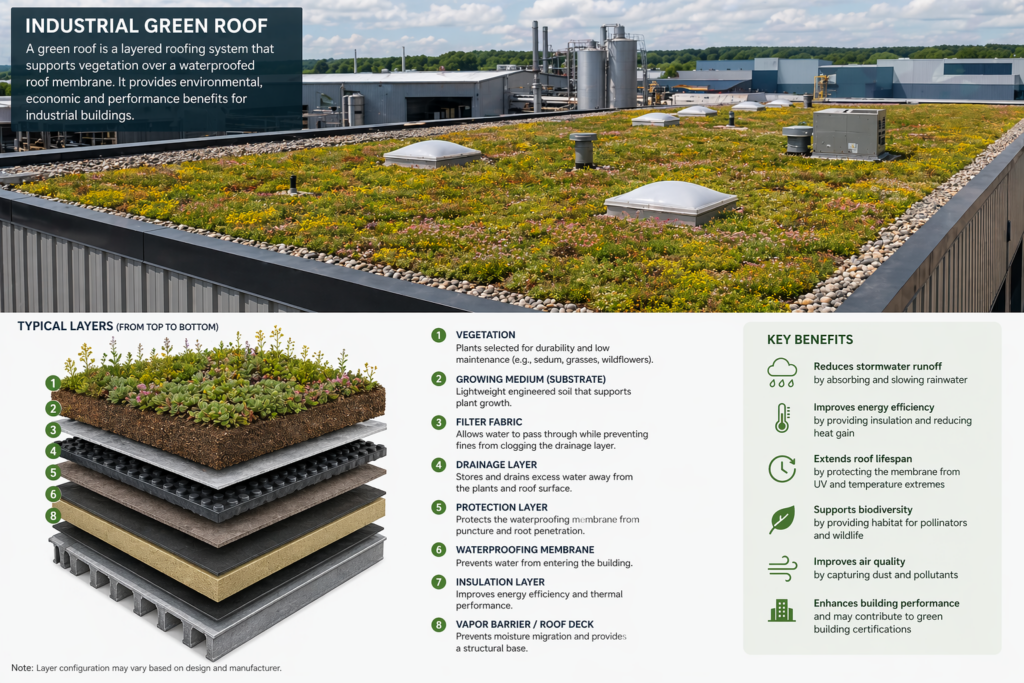
Green roof build-ups are layered systems. Waterproofing membrane. Root barrier (essential for siphonic HDPE pipe protection). Protection layer. Drainage board. Filter fleece. Substrate. Vegetation.
Siphonic outlets must integrate with all of these without compromising any of them. The outlet body penetrates the waterproofing and needs proper detailing to maintain integrity. The outlet rim must sit at the correct height relative to the drainage layer and substrate surface. Access provisions for inspection and maintenance need planning from the outset.
All rainwater outlets should be protected by inspection chambers with removable covers and surrounded by pebble vegetation barriers to prevent encroachment. This isn’t optional decoration. It’s fundamental to long-term functionality.
Managing Debris and Substrate Migration
Green roofs generate debris. Dead vegetation, wind-blown leaves, substrate fines migrating during heavy rainfall. This material gravitates towards outlets.
Capcon Engineering’s guidance stresses that a permeable membrane between outlets and vegetation is crucial. The membrane prevents excess debris entering the system and is particularly important during low-rainfall periods when self-cleansing flows don’t occur.
Here’s a key point often overlooked: once siphonic systems reach 10-15% of capacity, they become self-cleansing as high-velocity flow flushes debris through the pipework. But they need to reach that threshold first. Debris accumulation during dry spells can impede the system’s ability to prime properly when heavy rain finally arrives.
BS EN 12056-3:2000 recommends maintenance four times in the first year following installation, after which an appropriate regime can be established based on observed conditions.
Contained Roofs and Overflow Strategy
Green roofs typically sit behind parapets or upstands. This makes them contained areas where water has nowhere to go if primary drainage fails.
Secondary drainage and emergency overflow routes are essential design elements. The GRO Green Roof Code emphasises that secondary drainage should be located above landscaping levels.
Design for blockage scenarios, not best-case assumptions. What happens when debris accumulates faster than expected? When construction contamination wasn’t cleared? When the building changes hands and maintenance lapses?
Blue-Green Roofs and Controlled Discharge
The most sophisticated installations combine green roof attenuation with blue roof water storage and controlled release.
A structural attenuation layer beneath the green roof creates dedicated water storage. During normal conditions, water drains slowly through flow restrictors at greenfield runoff rates (typically 5-10 litres per second per hectare). During extreme events, the system can bypass restrictors, allowing rapid drainage.
Technical literature describes blue roof systems that attenuate water over 24 hours through restrictive outlets. Combined with green roof retention, the result approaches stormwater neutrality for all but the most extreme events.
For siphonic drainage designers, blue-green roofs introduce additional coordination. Flow restrictors interact with siphonic priming. Attenuation depths affect outlet positioning. Early engagement between specialists is essential.
Installation, Commissioning, and Long-Term Performance
Construction contamination ruins more drainage systems than design errors. Concrete slurry, mortar droppings, substrate fines from premature planting. None of this belongs in a siphonic system. Outlets need protection during waterproofing, substrate placement, and planting operations.
Before sign-off, verify that inspection chambers are accessible, debris screens in place, and anti-vortex plates correctly installed. Documentation must reflect green roof realities, not generic drainage manuals.
Seasonal inspections are essential. Green roofs change through the year. Autumn leaf fall accumulates at outlets. Winter die-back leaves debris. Spring growth encroaches on access routes. Siphonic systems demand planned preventive maintenance. By the time a blocked outlet becomes obvious, you’ve probably already experienced the flooding that results.
Common Mistakes to Avoid
Treating drainage as a late-stage M&E decision. Drainage strategy should inform structural and architectural design, not accommodate it.
Burying outlets under planting without access. Every outlet needs inspection access.
Assuming green roofs solve stormwater alone. They reduce and delay runoff. They don’t eliminate it.
Omitting overflow strategy on contained roofs. Parapets create bathtubs. Bathtubs need overflows.
No clear maintenance responsibility post-handover. Buildings change hands. Maintenance lapses.
When This Pairing Makes Most Sense
This combination works particularly well for large flat roofs in dense urban environments, developments with limited riser locations, projects aiming to reduce below-ground attenuation, and schemes where planning, sustainability, and long-term performance all matter.
It’s less critical for smaller roofs, pitched applications, or buildings with abundant space for conventional drainage.
FAQs
Do green roofs reduce the need for roof drainage?
They reduce drainage frequency for routine rainfall but cannot eliminate peak event requirements. Systems must handle extremes when substrate storage is saturated.
Are siphonic systems suitable for biodiverse or intensive roofs?
Yes, though additional attention to debris management and maintenance access is required. Deeper substrates increase debris risk at outlets.
How are outlets protected on planted roofs?
Through permeable membranes, gravel barriers, inspection chambers, and debris screens. Outlet surrounds should remain vegetation-free.
What happens if an outlet blocks during extreme rainfall?
On contained roofs without secondary drainage, water accumulates until it breaches upstands or overloads structure. Secondary systems are essential.
How does this support SuDS compliance?
It addresses source-control principles, managing rainwater at roof level before it enters ground-level infrastructure.
Conclusion: Designing Roofs That Work Harder
The days of treating roofs as afterthoughts are ending. Planning policy, sustainability targets, and climate resilience all demand rooftops that contribute to building performance rather than merely protecting it.
Green roofs and siphonic drainage work best when designed together rather than bolted on as separate systems. Early coordination between landscape architects, roof specialists, and drainage engineers delivers resilience, compliance, and long-term value.
The roof of the future isn’t just covered. It’s engineered.
Capcon Engineering is a global specialist in siphonic drainage systems with extensive experience integrating high-performance drainage with green roof installations across the UK, Europe, Asia and the Middle East. For project consultations or CPD seminars on siphonic drainage, contact our design team.