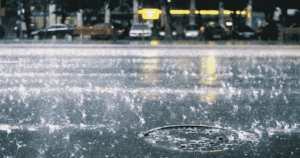
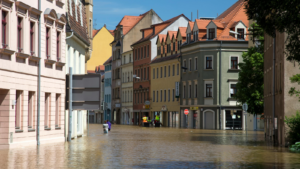
If you manage or design commercial buildings in the UK, here’s a number that should keep you awake at night: 4.6 million properties now sit in areas at risk of surface water flooding. That’s a 43% increase on previous assessments, according to Environment Agency data published in December 2024. Surface water flooding happens when rainfall overwhelms drainage systems. It’s not rivers bursting their banks. It’s the stuff coming off your roof.
The commercial property sector is waking up to an uncomfortable reality. Traditional drainage infrastructure wasn’t built for the rainfall intensities we’re now experiencing. And the regulatory landscape? It’s shifting beneath your feet, even if nobody can quite agree which direction it’s heading.
This isn’t a problem you can ignore until 2030. Buildings being designed today will still be standing in 2060. The stormwater strategy you commit to now determines whether your asset becomes a climate-resilient investment or an increasingly expensive liability.
The Policy Paradox: Where England Stands (and Stumbles)
Let’s address the elephant in the room. Schedule 3 of the Flood and Water Management Act 2010 was supposed to make Sustainable Drainage Systems (SuDS) mandatory for developments over 100m². Wales implemented it in 2019. England? Still waiting.
In September 2025, Parliamentary under-secretary Emma Hardy confirmed the government was effectively “mothballing” Schedule 3 in favour of a “planning policy-based approach”. Industry experts reacted with frustration. As Jacqueline Diaz-Nieto from the Environmental Protection Group put it: “We just seem to be going round and round in circles.”
DEFRA did publish new National Standards for SuDS in June 2025. Seven standards covering water quantity, quality, amenity, biodiversity, climate resilience, and long-term maintenance. The problem? Without Schedule 3 enacted, these standards lack statutory teeth. They’re guidance, not law.
What does this mean for you? Forward-thinking building owners aren’t waiting for mandatory requirements. They’re implementing robust stormwater management now, gaining a competitive advantage while others dither. The direction of travel is clear, even if the timeline isn’t.
Ten Trends Transforming Commercial Stormwater by 2030
1. SuDS Becomes the Default, Not the Exception
Despite the regulatory uncertainty, SuDS adoption is accelerating. The National Planning Policy Framework already expects Local Planning Authorities to promote sustainable drainage. Planning refusals for inadequate drainage strategies are becoming more common. Smart developers are building to the new standards regardless of their legal status.
The commercial case is compelling. SuDS components like permeable paving, rain gardens, and attenuation tanks can reduce downstream infrastructure costs significantly. When your surface water doesn’t need to connect to overwhelmed combined sewers, you avoid increasingly punitive charges from water companies.
2. Smart Drainage Goes Mainstream
Forget annual gutter inspections. The future is real-time monitoring.
IoT sensors tracking water levels, flow rates, and potential blockages are moving from pilot projects to standard specifications. The UK government has committed £40 million to real-time drought and flood prediction sensors. London boroughs like Sutton and Kingston deployed LoRaWAN flood monitoring networks after flash flooding in 2021, when hard, parched ground couldn’t absorb sudden downpours and grass clippings blocked manholes.
For commercial buildings, smart drainage means predictive maintenance rather than emergency callouts. Sensors detect partial blockages before they become complete failures. Building management systems integrate drainage data alongside energy and HVAC monitoring. The global stormwater management market is projected to grow from $5.27 billion in 2025 to $7.68 billion by 2030, with smart technology driving much of that growth.
3. Controlled Storage Replaces Simple Attenuation
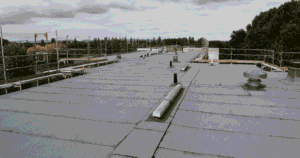
Basic attenuation tanks that passively hold and slowly release water are giving way to actively managed storage systems. Blue roofs with controlled outlets can hold water during peak rainfall, then release it when sewer capacity recovers. Some systems integrate weather forecast data to empty storage before predicted storms.
This matters because drainage infrastructure is increasingly about timing, not just capacity. If every building releases stored water simultaneously after a storm passes, you’ve just shifted the flooding problem downstream. Intelligent, coordinated release solves this.
4. Blue-Green Roofs Deliver Multiple Benefits
The UK has approximately 700 green roofs in central London alone, but we’re lagging behind European cities. Stuttgart mandates green roofs on new buildings. The Netherlands integrates them into its climate adaptation strategy.
Blue-green roofs combine water storage with vegetation. They reduce peak runoff by up to 50%, provide thermal insulation, create biodiversity habitat, and improve air quality. Modular systems like M-Tray make installation straightforward, even on existing structures.
The University of Salford is piloting smart blue-green roof monitoring, tracking surface water runoff impact alongside green infrastructure coverage. For commercial buildings, these systems contribute to BREEAM ratings while delivering measurable operational benefits.
5. Rainwater Harvesting Finally Makes Commercial Sense
Here’s where the numbers get interesting. Residential rainwater harvesting in the UK typically takes 15 years to pay back. Commercial installations? Often two to three years.
The difference is water consumption. Large commercial buildings with significant toilet flushing requirements, cooling systems, or irrigation needs use vastly more non-potable water. Higher consumption means faster payback. Major retailers, including Tesco and Sainsbury’s, have already implemented systems.
The global rainwater harvesting market is projected to reach $1.3 billion by 2034, with commercial applications driving growth. In the UK, the service segment alone is worth approximately £20 million annually.
6. Treatment at Source Becomes Standard
Water quality requirements in the new SuDS standards mark a significant shift. It’s no longer acceptable to simply move polluted runoff off-site quickly. Car parks accumulate hydrocarbons, heavy metals, and microplastics. Industrial sites can contribute chemical contaminants.
Proprietary treatment devices, bioswales, and filter drains that remove pollutants before discharge are becoming a standard specification. This protects receiving watercourses and reduces liability risk for building owners.
7. Retrofit SuDS Unlocks Existing Building Stock
New buildings are the easy part. The real challenge is retrofitting sustainable drainage to existing commercial stock. Permeable paving can replace conventional surfaces during routine maintenance cycles. Rain gardens can occupy underused landscaping areas. Rainwater harvesting tanks can slot into basements or car parks.
The commercial building retrofit market is substantial. Facilities management in the UK accounts for nearly 7.15% of GDP, with building maintenance representing a significant portion. Integrating drainage improvements into planned maintenance programmes makes financial sense.
8. Stormwater Becomes a Data Problem
Building owners increasingly view stormwater management through a data lens. Flow monitoring generates operational insights. Performance data supports ESG reporting. Predictive analytics optimise maintenance scheduling.
AI-driven systems are emerging that analyse weather forecasts, soil saturation levels, and historical performance to predict drainage behaviour. This transforms reactive maintenance into proactive asset management.
9. Drainage Integrates with Placemaking
Modern SuDS design moves beyond pure engineering into landscape architecture and urban design. Rain gardens become amenity features. Swales create green corridors. Water features incorporate attenuation functions.
For commercial developments, attractive SuDS components enhance lettability and user experience. They’re not engineering compromises hidden behind fences. They’re design features that add value.
10. Commercial Value Unlocks Climate Investment
The financial case for stormwater investment is strengthening. Insurance premiums increasingly reflect flood risk. Property valuations incorporate climate resilience. Tenants scrutinise ESG credentials.
Buildings with demonstrable stormwater management strategies command premium positioning in a market where sustainability credentials matter. The cost of not investing is becoming clearer as climate impacts intensify.
A Practical Roadmap: Where to Start
Quick wins (under £10,000): Install IoT water level sensors on existing drainage. Conduct a roof drainage capacity assessment. Map your current surface water discharge points and receiving infrastructure.
Medium-term improvements (£10,000-£100,000): Retrofit rainwater harvesting for toilet flushing. Replace conventional paving with permeable alternatives during scheduled maintenance. Install treatment devices on car park drainage.
Capital projects (£100,000+): Implement blue-green roof systems. Design comprehensive SuDS schemes for redevelopment projects. Install active storage with smart controls.
The key is starting somewhere. Even basic monitoring provides data that informs future investment decisions.
The Bottom Line
By 2030, successful commercial buildings will treat stormwater the way they currently treat energy: monitored, optimised, and reported. The technology exists. The commercial case is proven. The regulatory direction is clear, even if the timeline remains frustratingly uncertain.
Buildings designed today without a serious stormwater strategy are betting against climate science and market direction. That’s not a wager most informed investors would take.
The question isn’t whether to invest in stormwater management. It’s whether you lead the transition or get dragged along by it.