By Robert Finn, Operations Director, Capcon Engineering
When energy-from-waste (EfW) power plants are commissioned, the race is on to make them operational as quickly as possible, while maintaining a design that will stand the test of time. These buildings are among the most demanding environments a rainwater system can serve: with roofs 50m or more above ground, corrosive conditions, heavily serviced interiors and critical services that are difficult to access once the plant is running.
With this in mind, designing a rainwater system, while small on the overall scale of the project, is essential to the long-term performance of the power plant. A well-designed rainwater system will protect the infrastructure within the building while also providing lifelong protection against increasingly extreme rainfall events. Choosing the right drainage solution can also contribute to a project’s sustainability goals.
Getting this right comes with challenges for architects and consulting engineers, who are typically tasked with designing these systems alongside everything else within the building. This can often lead to the rainwater system being ‘kicked down the road’ to deal with at a later stage. This comes with significant risks like coordination issues detected far too late in heavily serviced environments, and undersized civil networks not accounting for increasing rainfall intensities.
These projects are also increasingly designed using architectural concepts like complex curved roof lines, intended to help them blend with their surroundings. These design considerations, along with the large scale of these buildings, often mean that traditional gravity pipework isn’t suitable.
Siphonic drainage can help mitigate these concerns, providing a modern solution to simplify the rainwater drainage strategy while ensuring the building is fully protected from extreme weather events. As siphonic drainage systems typically result in a raw material reduction of up to 70% compared to a conventional drainage system, it also means the long-term maintenance of the drainage system will be significantly simplified.
All of these factors mean it’s vital to choose a drainage solution, and a project partner with the right expertise and flexible approach, that can contribute towards keeping projects on time and on budget. It’s also valuable to bring them on board as early as possible in the process. This is where Capcon’s expert team comes to the fore.
Setting the stakes
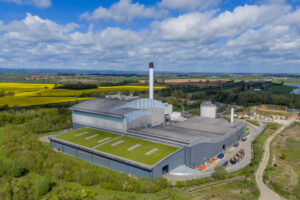
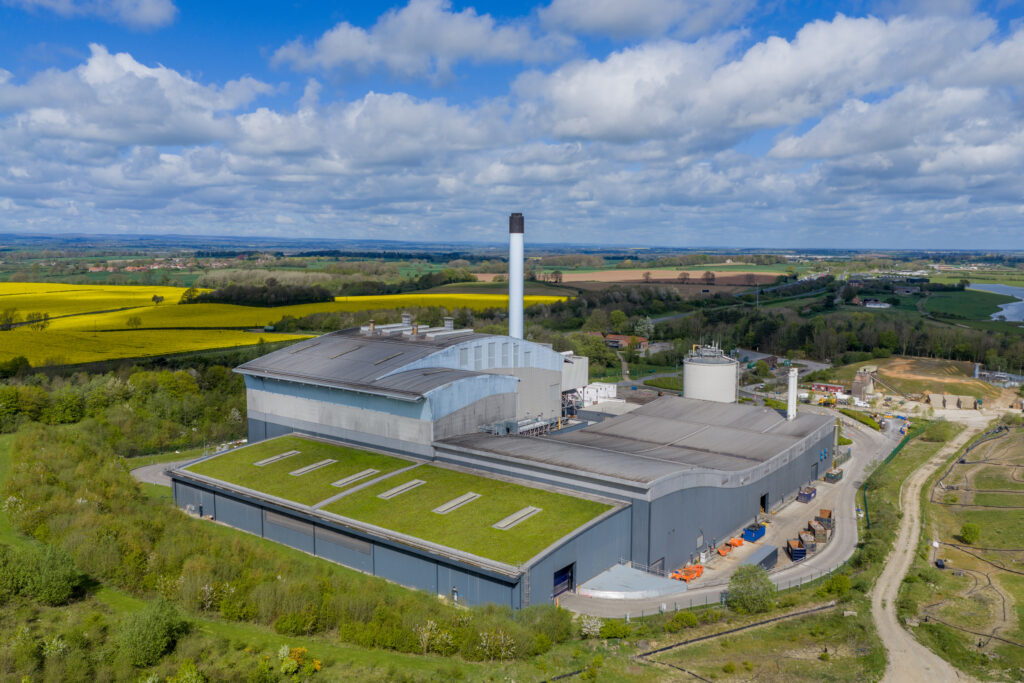
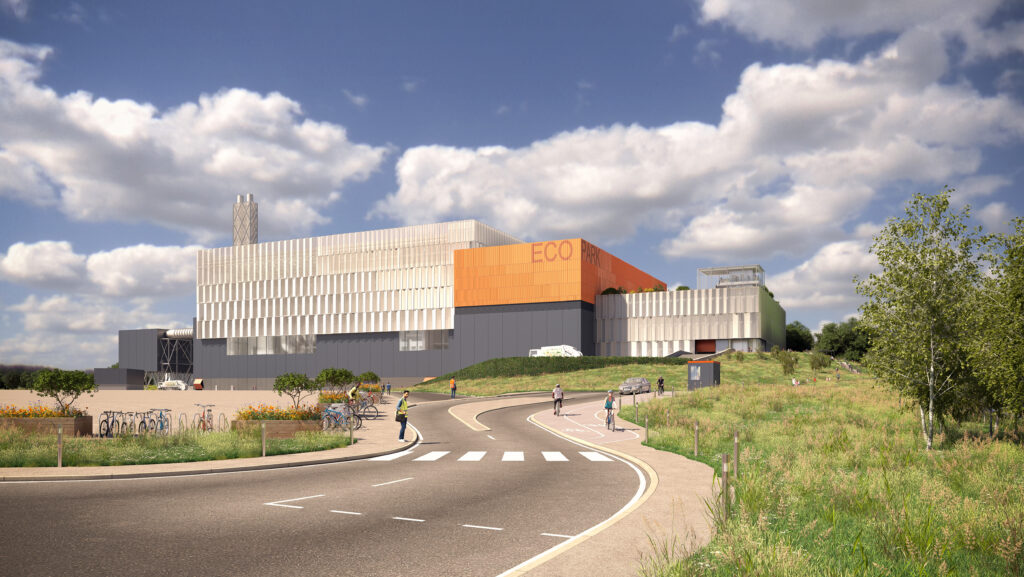
EfW power plants are complex sites, turning waste that would otherwise go to landfill into power and heat for tens of thousands of homes. Two recent projects that Capcon Engineering has worked on are North London Heat and Power Plant (NLHPP) in Edmonton and Thameside ERF at Tilbury Docks. When complete, the former will power 127,000 homes and heat 60,000 homes and businesses. The latter is scheduled to become operational in 2028, when it’s estimated to process close to 350,000 tonnes of non-recyclable waste per year, powering around 93,000 homes and feeding into the National Grid.
These projects are part of a broader trend across Europe where the EfW market is growing at an annual rate of 7.31%, according to Research & Markets. That’s being driven by trends like reducing waste sent to landfills and circular economy goals.
Financially, these infrastructure developments have a lot at stake: NLHPP is projected to cost £1.2 billion, for example. On projects of this scale, the primary objective is to get the facility operational as quickly as possible. Every day of delay carries considerable financial and operational consequences.
Often, drainage and envelope contractors are brought into the project at a later stage in the programme, working alongside the cladding contractor. In many cases, due to the scale of the plant and machinery within these buildings, the plant is already inside, and installers are tasked with putting the ‘skin’ around this complex machinery. It calls for drainage systems that can route around late-stage mechanical and structural alterations, and highly flexible installers who can adapt to those adjustments.
These adapted architectural designs introduce curved roofs, small isolated roof areas, and non-traditional geometries that conventional gravity drainage systems struggle to handle. Traditional drainage systems involve pipework that’s installed at a continuous gradient to allow water to flow, but this requirement is a major bottleneck within the congested overhead spaces of a modern EfW plant.
Routing a sloping pipe through a dense forest of turbine equipment, flue gas treatment systems, and electrical conduits leads to coordination issues, requiring multiple vertical drops that consume valuable space and disrupt equipment layouts. Each of these drops also requires below-ground civil drainage, which means you can have extensive runs of pipework buried under the building, but they are completely inaccessible—increasing the risk factor associated with a gravity design.

The siphonic solution
Siphonic drainage systems solve this routing conflict. Unlike traditional gravity drainage systems that require 66% air to move the rainwater through the system, siphonic systems are designed to eliminate that air, so the pipework operates completely full of rainwater. Through a combination of precisely engineered components and design, smaller-diameter pipework removes water from the roof at high speed.
The system’s high-velocity suction allows pipework to be routed horizontally at zero falls (with no gradient), which makes it much easier to coordinate in heavily congested environments and gives the design team a drainage system that can avoid the complex machinery and services located within the power plant. As many outlets can be combined together during these long horizontal runs, you also give the design team significantly more control over where the vertical downpipes are located to simplify the site-wide drainage, significantly reducing the need for below-ground civil drainage.
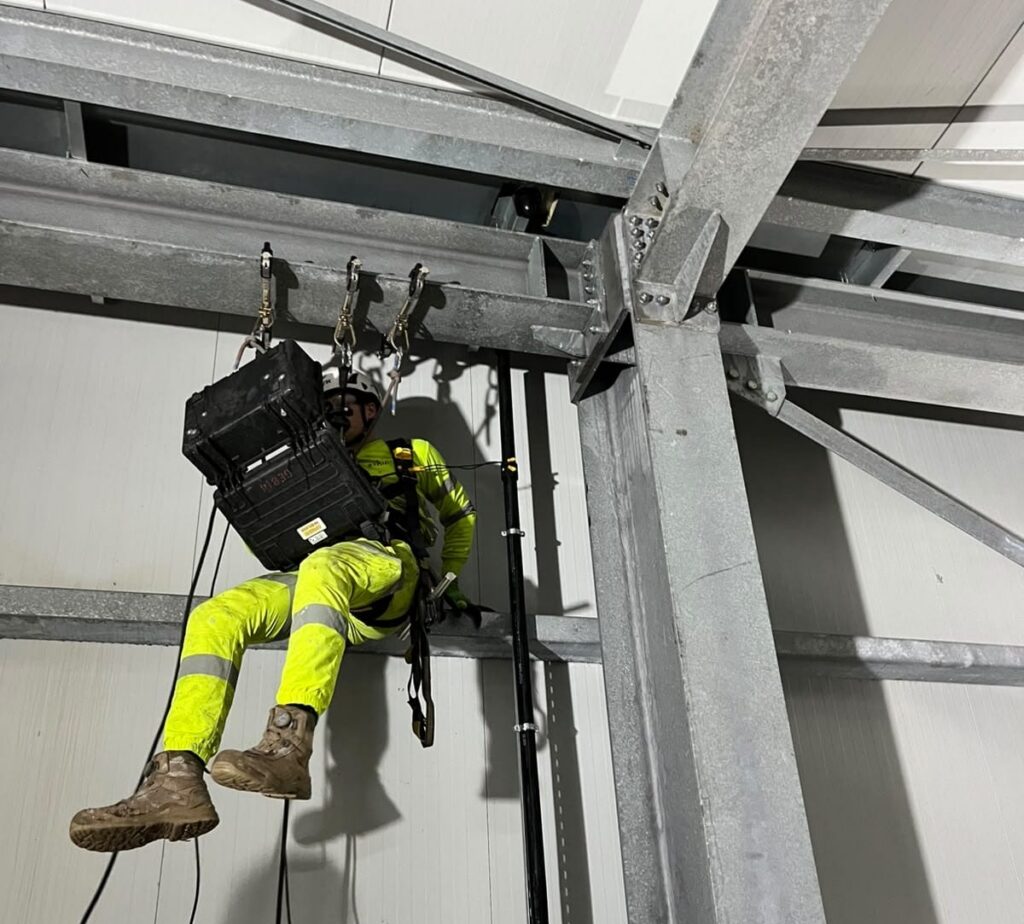
Access from above enabling SIM OPS
Another advantage of siphonic drainage is that it can be installed by rope access, where teams of certified, highly experienced abseilers install the pipework directly from ropes at the building’s cold face. This removes the need for scaffolding that’s built from the ground up, blocking areas below, so other mechanical, electrical and structural trades can keep working safely below. Installing a siphonic drainage system using rope access enables simultaneous operations, or SIM OPS. Capcon’s specialist expertise in this area means we can provide teams of certified abseilers with direct experience of working on large projects.
As an installation partner, we work hand in glove with other stakeholders on the project, to significantly speed up the construction programme and bring the plant online on schedule. Plus, there’s no compromise on safety, as all tools and pipework are tethered to prevent the risk of falling objects.
The key to working well with others is good communication. On a live EfW site that’s subject to change, it’s critical to make sure pipework installation matches the latest engineering drawings.

Better outcomes through communication and collaboration
Our approach is founded on flexibility to adapt to changes in the project, and our technology ensures these adjustments are communicated with all stakeholders, so designers and installers are all on the same page—literally. At Capcon Engineering, we use real-time field design software that installers can use to track late-stage routing obstacles on-site, and that engineers can use to troubleshoot and redesign routing paths in real time.
Using a mobile phone or tablet, the team on site can instantly capture photos, take measurements, and mark up drawings directly within the software. Because this information syncs in real-time, designers back at the office can view the exact same site conditions instantly. It also generates fully detailed field reports that are sent straight to the client.
In our experience, verifiable, visual data creates clarity and efficiency, especially on large-scale construction projects. Visualisation software lets the project team secure agreement from all the necessary stakeholders and make immediate collaborative decisions that keep the build moving on time and within budget. Projects of this scale require delivery to match. Using technology in this way keeps all site communication fact-based and accurate, so decisions can be made promptly and delays on site are avoided.
How siphonic drainage meets sustainability goals
EfW power plants’ emissions mean they can’t be considered a ‘renewable’ energy source, which is why consulting engineers will often need to identify decarbonisation opportunities in other parts of the plant’s design and construction. Siphonic drainage is inherently more sustainable than traditional gravity drainage. Because the systems operate under high-velocity vacuum flow, they need smaller pipe diameters than gravity systems. This reduction in pipe size, and consolidation of multiple downpipes into a single drop, can reduce raw materials by up to 70%, removing tonnes of material from the project and lowering its embodied carbon.
What’s more, by minimising the number of vertical drops, siphonic systems dramatically reduce the requirement for underground civil drainage works involving diesel-operated machinery needed for excavation, trenching and backfilling. This method can also reduce installation time by 30–35%, which means siphonic drainage can make a significant contribution to a project’s environmental goals while also delivering significant programme benefits.
Exceeding the standards to meet rising rainfall
Any drainage system has one goal above all: keeping the internal space of the power plant dry to protect highly sensitive, high-value generation equipment inside. This has become much more difficult due to rapidly shifting global rainfall patterns.
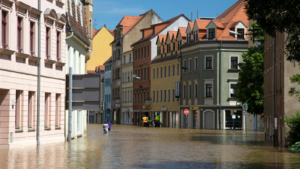
It’s often said that rainfall events have increased in recent years. In truth, annual averages have not increased significantly, but there has been a significant rise in the peak intensity of rainfall, meaning we are getting heavier rainfall over shorter periods. This means the proper design of the rainwater system has never been more important to ensure the building is adequately protected.
Siphonic drainage was originally developed in the 1960s, when engineering standards and calculations were far less consistent than they are today. Rainfall data has improved significantly since then, but long-term rainfall information can still be outdated. That’s why, when specifying a design rainfall intensity for any project, it’s important to look at both historical long-term averages and recent peak rainfall to ensure the building is adequately protected.
Standard codes like BS EN 12056-3:2000 (for gravity and general rainwater drainage) and BS 8490:2025 (for siphonic rainwater drainage) provide a solid baseline, but they predate how climate change has affected weather patterns. Our ethos at Capcon is ‘everything above and beyond code’. This allows us to mitigate structural and operational risks of under-sizing a drainage system, such as water pooling that leads to roof collapse, or foundation washout where the underground drainage can’t handle the pressure of the water coming through siphonic systems.
We constantly audit our work from a safety and quality perspective. Our design team goes on site and checks that everything is as per design, and all of the pipework is bracketed and braced correctly.
Getting it right from the start
Today’s power plant projects are a combination of architectural complexity and compressed timelines. They also have to contend with the realities of climate-driven higher rainfall events. We urge consulting engineers to treat drainage as an integral part of the project and to consider highly engineered, siphonic solutions. With less pipework and less material, they’re more cost-effective, while the fast installation ensures tight project deadlines stay on track.
The key to achieving these benefits is to engage with specialist designers early. Independent research and our own experience show that investment in waste-to-energy projects is growing, helping to deliver the infrastructure that a low-carbon future depends on, in the UK, Ireland and beyond.
That’s why it’s more essential than ever to start these projects right. Choose a partner that’s experienced, flexible and collaborative, and that goes above and beyond the code to deliver lasting project outcomes, with facilities that are resilient to whatever the climate can throw at them.
Simple solutions in complex environments—this is what Capcon prides itself on. By engaging Capcon’s expert team early on, you can rest assured that the drainage system will stand the test of time while providing significant time, cost and sustainability benefits to the project.
Find Out More About What We Do
Contact Capcon Engineering to discuss your project’s specific drainage requirements with our specialist team.