A roof in Vietnam has to survive typhoon rain bands in the north, a long wet season in the south and, on delta sites, ground that is often saturated before the storm even arrives. Capcon Engineering designs, supplies, installs and maintains siphonic roof drainage for projects across Vietnam, backed by more than 15 years of rainwater engineering, and we work alongside architects, main contractors and M&E consultants from first sketch to handover.
Working on a live project? Send us your tender drawings or outline brief via our tender page, and our siphonic drainage experts will review the options with you.
What is Siphonic Drainage?
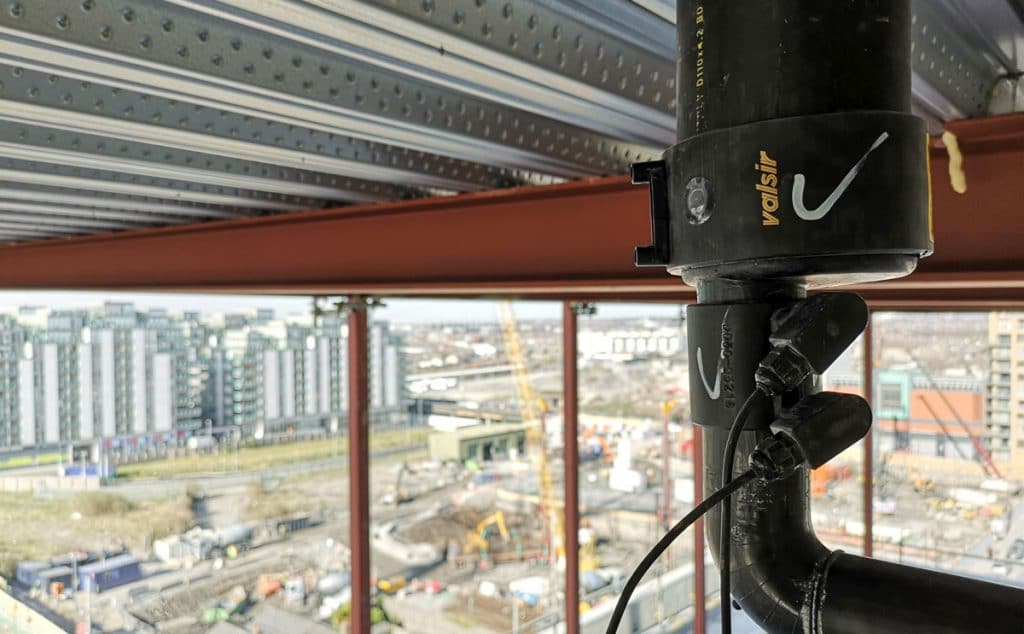
Siphonic drainage uses engineered outlets that keep air out of the pipework, so the pipes run completely full and negative pressure pulls water off the roof far faster than gravity alone could. Collector pipes can sit level beneath the roof, gathering flow from many outlets into a handful of downpipes; you will find the full siphonic drainage explanation on our UK and Ireland page.
Why does this matter in Vietnam? Because the system is hydraulically designed around local rainfall intensity and roof geometry, and Vietnam’s rain comes in heavy, concentrated bursts. Ho Chi Minh City receives around 1,950 mm a year, with more than 200 mm a month from May to October. Hanoi sees around 1,600 mm, most of it between May and September.
Why Choose Siphonic Instead of Gravity in Vietnam?
For a big Vietnamese roof facing the storm after next, three advantages stand out:
- Sized for typhoon rain bands: full pipes moving at speed let you design for the short, violent bursts a typhoon or monsoon cloudburst delivers, not for an ordinary wet afternoon.
- Less buried pipe on delta ground: fewer downpipes means fewer trenches on low-lying Mekong and Red River delta sites, where a high water table makes every buried run harder work.
- Typical cost savings of 20 to 45% compared with conventional gravity-based systems.
Send us a roof and its design storm criteria, and we will set siphonic against gravity for you, side by side.
Additional Protection Against Extreme Weather Events in Vietnam
Vietnam is affected by six to eight typhoons or tropical cyclones a year, with thunderstorms on 20 to 80 days a year.
Typhoon Yagi made landfall over Haiphong and Quang Ninh on 7 September 2024, the strongest typhoon to hit the country in decades. The government put the damage at more than 81.5 trillion dong, about US$3.31 billion. In the industrial zones, the roofs of several factories were blown apart while water seeped into industrial units, damaging finished goods and expensive equipment. Roofs and rainwater sat right at the centre of the losses.
Then came 2025. On 10 May, nearly 230 mm of rain fell in just 90 minutes in Ho Chi Minh City. Ninety minutes. Picture that on a large warehouse roof with a handful of gravity outlets.
Looking ahead, an AFD study of rainfall extremes in Vietnam projects moderate increases in precipitation intensity of 3.3% to 7.8% across global warming levels, with high uncertainty between models.
Siphonic drainage systems are increasingly important in Vietnam because they:
- Clear a typhoon rain band off the roof as fast as it lands, at intensities where a gravity outlet is already running full and backing up.
- Keep water from pooling against the membrane or finding its way into the server hall, the cleanroom or the racking below, which is where the Yagi losses came from.
- Fit the short-duration design approach Vietnamese practice already uses: the Ministry of Construction’s draft internal drainage standard sizes roof drainage on a 5-minute rainfall intensity.
- Give the building headroom for the storm after next, in a climate where rainfall extremes are projected to intensify.
- Leave the overflows as a last resort rather than a regular event.
Capcon Are the Siphonic Specialists
Rainwater drainage is all we have done for more than 15 years, on pharmaceutical plants, data centres, airports and factories from Ireland to Asia-Pacific, and that narrow focus matters when the design storm keeps moving.
Vietnam is covered from our APAC offices in Kuala Lumpur and Singapore. Ho Chi Minh City is under two hours’ flight from Kuala Lumpur and about two and a half hours from Singapore; Hanoi is roughly three to three and a half hours from either office. That puts an engineer on your site for a roof survey, a design workshop or a commissioning test without a week’s notice, while the hydraulic calculations and BIM coordination run from the office alongside your local design team.
Expertise and Track Record Relevant to Vietnam
The projects behind that claim are the ones a Vietnamese specifier would recognise:
- Singapore pharmaceutical plants, plus GMP facilities for global manufacturers in France, Italy and Ireland, which is the same coordination discipline Vietnam’s new EU-GMP plants will need.
- Data centres in Asia, Johor included, where uptime and water efficiency set the brief, exactly the brief now being written for the campuses around Ho Chi Minh City and Hanoi.
- Changi Airport Terminal 5, under construction in Singapore, a roof on the scale of Long Thanh’s terminal and a case where siphonic outlets were the only sensible answer.
- Factories and industrial halls across Europe and APAC, from electronics to logistics, where the space and cost savings show up on the tender price.
Every one of those was designed with the roofing, structural and M&E teams in the same model, so the drainage matched the design storm and the client’s performance spec rather than fighting the rest of the building.
Excellence in Design and Production
Our in-house engineers run the hydraulic calculations to BS EN 12056-3, BS 8490 and ASPE/ANSI 45, so the numbers will be familiar to the international consultants already active in Vietnam.
Locally, Vietnam’s QCVN regulations are mandatory while TCVN standards are voluntary, and designers may apply recognised international standards provided the QCVN requirements are met. The current internal drainage design standard, TCVN 4474:1987, predates siphonic practice. The Ministry of Construction has circulated a draft replacement standard for internal drainage in buildings. The 2023 draft includes a section on siphonic rainwater drainage, recommends siphonic systems for large buildings with wide roofs, and lists BS EN 12056 in its reference literature. It remains a draft. We work with your local design team to confirm which regulations and local authority requirements apply to your site.
We coordinate every outlet and collector in 2D and 3D BIM and, where it makes sense, prefabricate pipework off-site, which cut on-site labour by approximately 20% on past pharmaceutical projects and means less time working on an exposed roof in the wet season. Because we are manufacturer-agnostic, we specify whichever system suits the roof and the climate, including Valsir Rainplus, Hydromax and Blucher stainless steel.
Installation, Maintenance and Upgrades
Our own crews install the siphonic pipework and outlets, then keep the system performing through planned maintenance, surveys and repairs, all set out on our siphonic drainage service page. The south’s rainy season runs from May to November, the north’s from late April or May to October. Book the outlet clean before your region’s rains begin and a check after the first typhoon has passed, and bear in mind that older systems may have been sized for storms gentler than today’s.
Where Siphonic Roof Drainage Works Best in Vietnam
Siphonic roof drainage systems are particularly well-suited to the types of large-footprint buildings driving Vietnam’s construction growth:
- Data centres and cloud infrastructure: Vietnam had 41 active data centres with a total power capacity of 221 MW in 2025, and foreign companies can now fully own and operate them. Water in a data hall is not an inconvenience. It is an outage.
- Electronics and advanced manufacturing: Samsung’s plants in Bac Ninh and Thai Nguyen, and Intel’s assembly and test site at Saigon Hi-Tech Park, show the scale of foreign manufacturing in Vietnam. Exactly the congested, high-value buildings where siphonic drainage outperforms gravity.
- Logistics and ready-built factories: The Southern Key Economic Region holds approximately 6.5 million m² of ready-built factory and warehouse space at 92% occupancy, with around 5.1 million m² more in the north. Big, flat roofs with few internal columns to hang downpipes from? Siphonic territory.
- Airports and transport infrastructure: Long Thanh International Airport is set for commercial operation in the fourth quarter of 2026, with an eventual capacity of 100 million passengers a year. Terminals like this are natural siphonic projects.
- Pharmaceutical and commercial buildings: GMP-grade plants, malls and exhibition halls all benefit from fewer downpipes and freer ceiling voids.
No two of these roofs get the same system. We size each one to the building’s use, its site, the roof geometry and where the water can legally go, using Vietnamese rainfall data and the design storm agreed with your consultant.
Supporting Vietnam's Sustainability and Water Management Goals
Vietnam committed to net zero by 2050 at COP26, and its National Green Growth Strategy asks the Ministry of Construction for green materials and energy-efficient construction standards.
LOTUS, the rating system developed by the Vietnam Green Building Council, treats water as a mandatory category and rewards alternative sources such as rainwater. The results in the factory sector are striking: LOTUS-certified factory projects recorded an average water saving of 44%, and VGBC notes that large roofs suit rainwater storage in monsoon climates like Vietnam’s. Siphonic drainage does not earn those savings on its own. But by channelling roof runoff efficiently into rainwater harvesting or attenuation storage, it can support a project’s case for them.
LEED and EDGE projects benefit in the same way. For data centres, where cooling makes water a critical operational resource, pairing siphonic drainage with rainwater harvesting can directly improve water efficiency.
How We Support Different Project Stakeholders in Vietnam
For architects, we test early whether a siphonic scheme can cope with Vietnam’s typhoon rainfall on your chosen roof form, then place outlets and routes so downpipes stay off the facade and out of valuable internal space. Main and M&E contractors get buildable, clash-checked designs and prefabricated pipework that goes in quickly between wet-season downpours, with our support through testing and commissioning. M&E consultants and specifiers receive full hydraulic calculation packs, independent checks of third-party schemes and advice on pairing siphonic outlets with attenuation or rainwater harvesting where a high water table or a stretched local network limits how fast a site can discharge.
Our CPD “An Introduction to Siphonic Drainage” is approved by Engineers Ireland and certified by CPD UK, and can be delivered virtually or in person to project teams and design practices in Vietnam.
Contact Our APAC Team
Projects in Vietnam are handled by our APAC team, reachable at either office:
Capcon Engineering, Kuala Lumpur
L12-6 Menara Sentral Vista, Kuala Lumpur
Phone: +6012 385 1975
Email: info@capconeng.com
Capcon Engineering, Singapore
141 Cecil Street, 04-05 Tung Ann Building, Singapore 069541
Phone: +6012 385 1975
Email: info@capconeng.com
Send us your drawings and design criteria at any stage, from tender to a review of an existing system, and one of our siphonic engineers will come back to you with options.
Siphonic Roof Drainage Experts
Meet Donnacha Tobin
Find out how we can design and supply a bespoke siphonic drainage solution for your next project by speaking directly with our Divisional Director.